

Rust for Bioinformatics: A Curated Collection of Libraries and Tools
We survived a week learning Rust in a very hot attic above our labs—and somewhere along the way, we built a small public collection of Rust libraries and tools for bioinformatics.

Access to the Rust Bioinformatics Bookmark Collection.
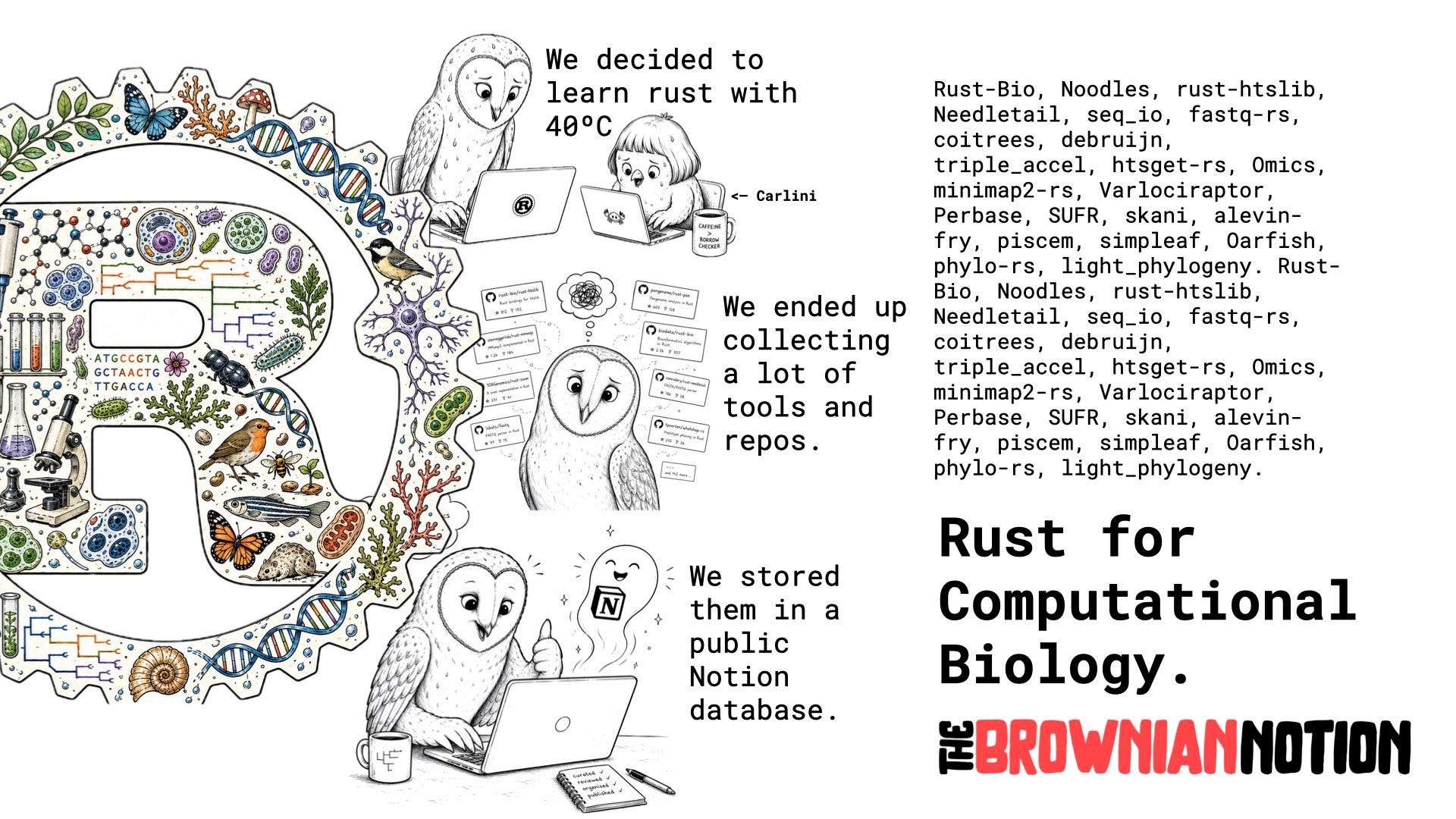
Looking for a fun way to survive a July heatwave in the age of climate change? Here at the Institute of Evolutionary Biology (IBE) in Barcelona, we decided to spend an entire week learning Rust in the attic above our labs, right under the PRBB roof.
Rust has enormous potential for computational biology and evolutionary research, and this week marks the beginning of a broader initiative that I hope to write more about in the future.
Meanwhile, while preparing for our little Rust bootcamp, we started collecting interesting libraries and repositories. One link led to another, and before we knew it we had accidentally assembled a public database of Rust software for bioinformatics. It would have been a shame not to share it as a public Notion page.
A small database of rust bioinformatics tools.
Here we present our curated collection of Rust libraries, applications, workflows, and repositories for computational biology. It’s not meant to be exhaustive—just a growing collection of projects that we find interesting, useful, or worth keeping an eye on.
Most of the current ecosystem is centered around genomics and sequencing, but we’re also tracking emerging projects in phylogenetics, evolutionary biology, and other areas as they appear. The database will continue to evolve alongside the Rust bioinformatics ecosystem itself.
You can browse the collection here.
At the moment we’re still working through the collection, adding descriptions, reviewing projects, and discovering new ones. The database is very much a work in progress, so if you know of a Rust project we’ve missed—or spot something that could be improved—contributions, suggestions, and corrections are always welcome (mail: fabio.barteri@upf.edu).
What does the current Rust bioinformatics ecosystem look like?
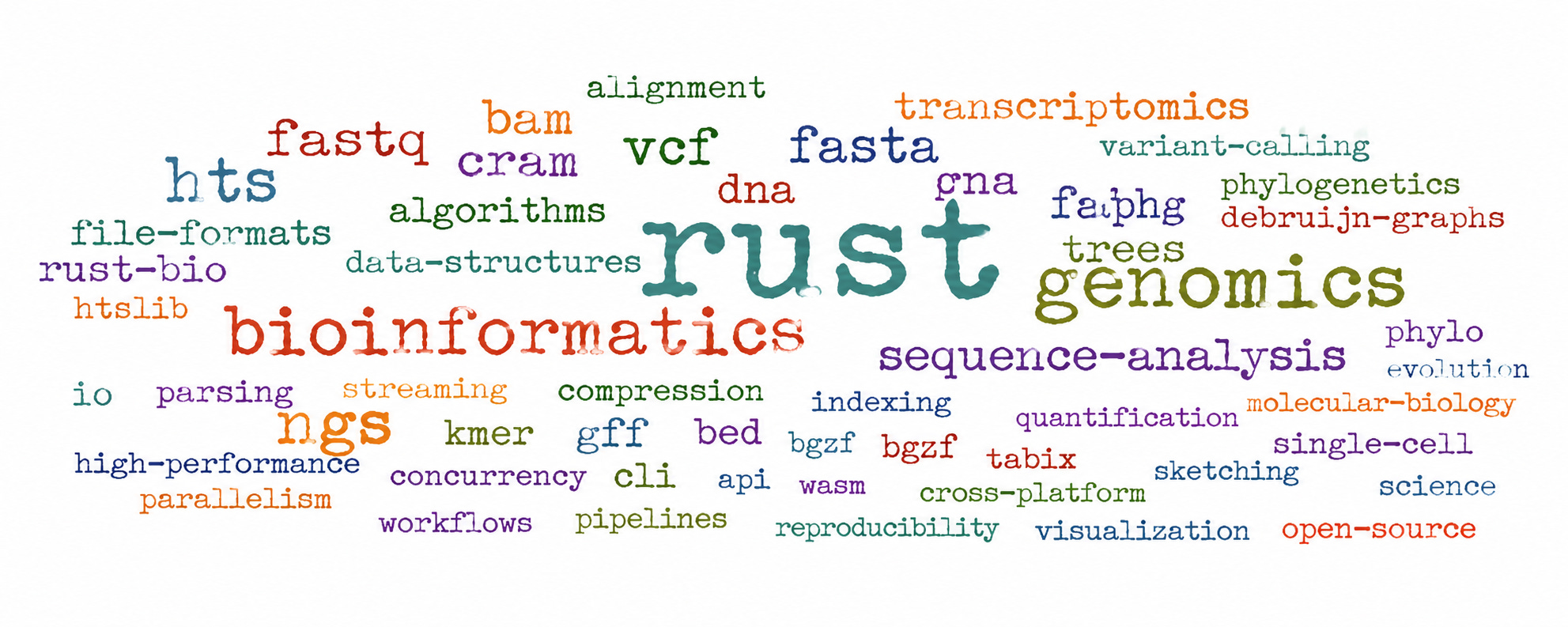
At the moment, the database is dominated by projects that address the core infrastructure of modern genomics. This is perhaps not surprising: Rust’s strengths—performance, memory safety, and concurrency—make it particularly attractive for building the low-level libraries and high-throughput tools that underpin sequencing data analysis.
The ecosystem is still relatively young, and some areas are much more mature than others. Genomics and sequencing workflows are already well represented, while evolutionary biology and phylogenetics remain comparatively underdeveloped. That said, several promising projects have emerged over the last few years, suggesting that this gap is beginning to close.
General-purpose Rust libraries for computational biology
A first group of projects provides reusable building blocks rather than end-user applications. Libraries such as Rust-Bio have become the de facto standard toolkit for sequence analysis algorithms, while Noodles and rust-htslib offer robust support for reading and writing the file formats that power modern genomics. Other crates—including Needletail, seq_io, debruijn, coitrees, and triple_accel—focus on efficient sequence parsing, graph algorithms, interval indexing, and high-performance string processing. Although these libraries are not tied to a specific biological question, they form the foundation upon which many bioinformatics applications are built.
Genomics and sequencing applications
The largest portion of the ecosystem is dedicated to genomics. This includes sequence alignment (minimap2-rs), variant calling (Varlociraptor), coverage analysis (Perbase), suffix-array indexing (SUFR), and genome similarity estimation (skani). Single-cell transcriptomics is particularly well represented through the COMBINE Lab ecosystem, with projects such as piscem, alevin-fry, simpleaf, and Oarfish covering lightweight mapping, quantification, and workflow management. Together, these projects demonstrate that Rust has already become a credible platform for developing production-grade genomics software.
Evolutionary biology and phylogenetics
Compared with genomics, the evolutionary biology ecosystem is still small but steadily growing. General-purpose libraries such as phylo-rs provide data structures and algorithms for phylogenetic analysis, while light_phylogeny focuses on tree manipulation, reconciliation, and visualization. Other specialized tools, such as PhyloDM, address efficient computation of phylogenetic distance matrices. Although this ecosystem is far from matching the breadth of established Python or R libraries, it represents an encouraging foundation for future development in comparative and evolutionary biology.
The Brownian Notion Mixtape
No issue of The Brownian Notion would be complete without a mixtape. This is where I collect a handful of papers, preprints, software releases, blog posts, and the occasional oddity that caught my attention while wandering through computational and evolutionary biology. There’s no unifying theme—just a selection of ideas that I think are worth reading, thinking about, or simply keeping on your radar.
[Genome Evolution] Segmentally Duplicated Regulatory Elements Undergo Human-Specific Rewiring
Link: https://academic.oup.com/mbe/article/43/7/msag140/8723564
Segmental duplications are often discussed in the context of gene evolution, but this study turns the spotlight onto their regulatory sequences. The authors show that duplicated regulatory elements have been extensively rewired during human evolution, revealing how genome duplication can generate new patterns of gene regulation and contribute to the emergence of human-specific traits.
[Computational Ecology] Detecting Ecological Thresholds with a Mechanistic Modeling Framework
Link: https://journals.plos.org/ploscompbiol/article?id=10.1371/journal.pcbi.1014411
A nice example of theoretical ecology tackling a practical conservation problem. The authors develop a mechanistic modeling framework to identify ecological tipping points and critical thresholds, showing how mathematical models can guide real-world management decisions by predicting when ecosystems are approaching irreversible change.
[GWAS] The Phenotyping Bottleneck in Genome-Wide Association Studies
Link: https://journals.plos.org/pl
oscompbiol/article?id=10.1371/journal.pcbi.1014431
As genotyping has become cheaper and more scalable, phenotyping has emerged as one of the major bottlenecks in genome-wide association studies. This Perspective discusses why accurately measuring phenotypes remains such a difficult challenge and reviews computational approaches—from electronic health records to imaging and wearable devices—that are helping to close the gap between abundant genomic data and high-quality phenotype information.
[PLOS CompBio +20] Twenty Years of PLOS Computational Biology
Link: https://journals.plos.org/ploscompbiol/article?id=10.1371/journal.pcbi.1014471
Published to celebrate the journal’s twentieth anniversary, this perspective offers a concise overview of how computational biology has evolved over the past two decades. From the early days of genome-scale analyses to today’s AI-driven methods, it’s an interesting snapshot of the field’s transformation—and a reminder of how computational biology has become a central pillar of modern life sciences.